
That is the answer most people came for. The more interesting question is the second one — why the American holiday for workers sits in September, when most of the world marks it on 1 May.
The Date Was a Political Choice
It was not chosen for the weather, or for the end of summer, or to round off the school holidays.
1 May already belonged to somebody else. International Workers’ Day was associated with more radical strands of the labour movement, and the American government wanted a workers’ holiday that carried none of that association. September was, above all, not May.
It Started on a Tuesday
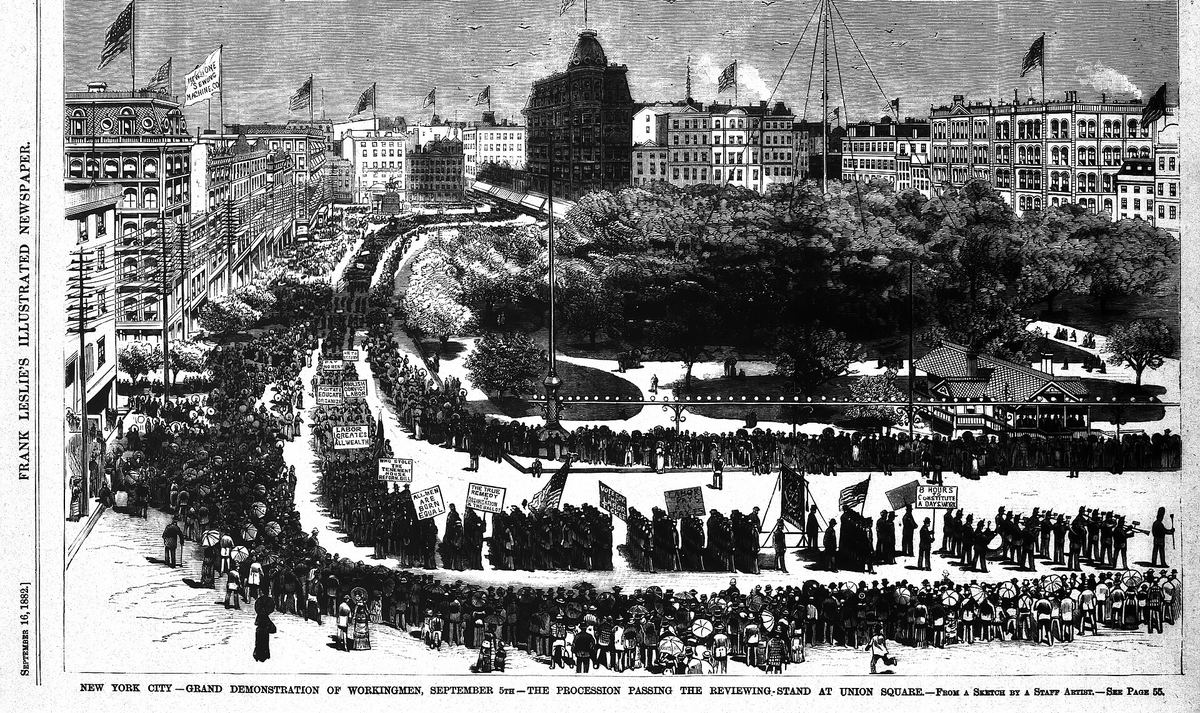
The first American Labor Day parade was held on Tuesday 5 September 1882, organised by the Central Labor Union of New York, with the procession passing a reviewing stand at Union Square.
The banners in the contemporary illustration of that march are worth reading: Labor creates all wealth. Eight hours constitute a day’s work. Agitate, educate, organise. It was a demonstration with demands, not a day off.
The idea spread. Individual states began adopting it, and by 1894 thirty states had a Labor Day on the first Monday in September.
The Six Days That Explain the Federal Holiday
Here is the part that tends to be left out of the cheerful version.
The national holiday honouring American workers was signed into law in the immediate aftermath of the federal government crushing a strike by them. Whatever else it was, it was also a peace offering, and it was made in a hurry.
Note too what Congress did not do: it did not choose the date. Thirty states had already settled on the first Monday in September, and the federal law simply adopted what was already there.
So Why Do We Celebrate Labor Day?
The honest answer has two layers, and both are true.
- The stated reason: to recognise the contribution of American workers to the country’s prosperity — the reason given in 1894 and repeated every year since.
- The historical reason: because organised labour built the day themselves in 1882 and made it impossible to ignore, and because in 1894 a federal government that had just broken a strike had strong reasons to grant it.
Why Can’t You Wear White After Labor Day?
Start with the honest bit: nobody actually knows. There is no founding document for this rule, and historians describe its origins as murky.
The best-supported explanation has nothing to do with clothing and everything to do with class.
In the late nineteenth and early twentieth centuries, New York’s newly rich were pressing to join an established social elite that did not want them. White clothing had become associated with wealth and leisure — the summer wardrobe of people who left the city for the coast or the lakes. Labor Day marked the end of that season and the return to town, and putting the white away became one of a set of unwritten rules.
Etiquette writers — Emily Post above all — then standardised it and carried it out of high society and into middle-class America, which is how a private social signal became something everyone had heard of.
It has been declared obsolete repeatedly since the 1990s, including by Vogue. Wear the white.
Frequently Asked Questions (FAQ)
When is Labor Day 2026?
Monday 7 September 2026 — always the first Monday in September. The long weekend is 5–7 September.
Why do we celebrate Labor Day?
To recognise the contribution of American workers. It began as a labour demonstration in 1882 and became a federal holiday in 1894, six days after the Pullman Strike ended.
Why is Labor Day in September and not on 1 May?
Because 1 May was already associated with more radical labour movements, and the US government wanted distance from them.
Why can’t you wear white after Labor Day?
The origins are murky. The most widely accepted explanation is that it was a class marker among the wealthy at the end of the summer resort season, standardised by etiquette writers. It has been considered obsolete since the 1990s.
When was the first Labor Day parade?
Tuesday 5 September 1882, organised by the Central Labor Union of New York, passing a reviewing stand at Union Square.
Date of the first parade, the adoption of the first Monday in September by thirty states, the 1894 federal holiday legislation signed by President Grover Cleveland six days after the end of the Pullman Strike, and the reasoning behind September rather than 1 May per HISTORY and published accounts of the holiday’s origins. The origin of the “no white after Labor Day” convention is not documented and is presented here as the most widely accepted explanation rather than established fact. Image: “New York City — Grand Demonstration of Workingmen, September 5th”, Frank Leslie’s Illustrated Newspaper, 16 September 1882 (public domain), cropped.