
The question people actually ask is “what temperature is a heat advisory?” — and the honest answer is that there isn’t one. That is not a dodge. It is the whole design.
The Three Levels
| Alert | What it means |
|---|---|
| Heat Advisory | The lowest level. Dangerous heat is happening, but not at warning level. |
| Extreme Heat Watch | Conditions are favourable for extreme heat — not certain yet. Prepare. |
| Extreme Heat Warning | Extremely dangerous heat, typically expected within 24 to 36 hours. Act. |
The watch-versus-warning logic is the same as everywhere else in the weather service: a watch means conditions are favourable, a warning means it is happening or about to.
Why the Number Changes by State
This is the part that surprises people. The criteria are set locally, and they differ enormously:
| Where | Example threshold |
|---|---|
| Maine | Heat index 95°F for at least two consecutive hours → Heat Advisory |
| Panhandle, north & central Florida | Heat index above 108°F → Heat Advisory |
| Most areas (warning level) | Heat index 105°F+ for more than 3 hours a day on 2 consecutive days, or heat index above 115°F for any period |
So “only 95 degrees and they issued an advisory?” is not an error. In a cool climate, 95 is the dangerous number.
It Is the Heat Index, Not the Temperature
Every threshold above is a heat index, not what the thermometer reads. The heat index combines temperature and humidity to express what the air actually does to a human body.
That is why a humid 95°F day can carry a higher heat index — and a more serious alert — than a dry 100°F day.
Why You Still See “Excessive Heat Warning”
Because it was the official name until recently. On 10 March 2025 the National Weather Service renamed the Excessive Heat Warning and Watch to the Extreme Heat Warning and Watch, following public survey work from 2018.
Both terms describe the same product. If a page uses the old wording, it predates the change — it is not describing a different alert.
What to Do at Each Level
- Advisory — limit outdoor exertion in the hottest hours, drink before you feel thirsty, check on elderly neighbours.
- Watch — plan now: move outdoor work earlier, find your nearest cooling centre, make sure cooling works.
- Warning — treat it as dangerous. Stay out of the heat, never leave anyone in a parked car, know the signs of heat stroke.
Frequently Asked Questions (FAQ)
What temperature is a heat advisory?
There is no national number. Maine can issue one at a heat index of 95°F; parts of Florida need above 108°F.
What is the difference between a heat advisory and an extreme heat warning?
An advisory is the lowest level. A warning means extremely dangerous heat, usually within 24–36 hours.
Why do the thresholds change by state?
Because acclimatisation differs. People used to hot climates are affected at higher temperatures.
Is it an excessive heat warning or an extreme heat warning?
Extreme — renamed from Excessive on 10 March 2025. Same product.
What is the heat index?
Temperature plus humidity — what the air actually feels like to a human body. All heat thresholds use it.
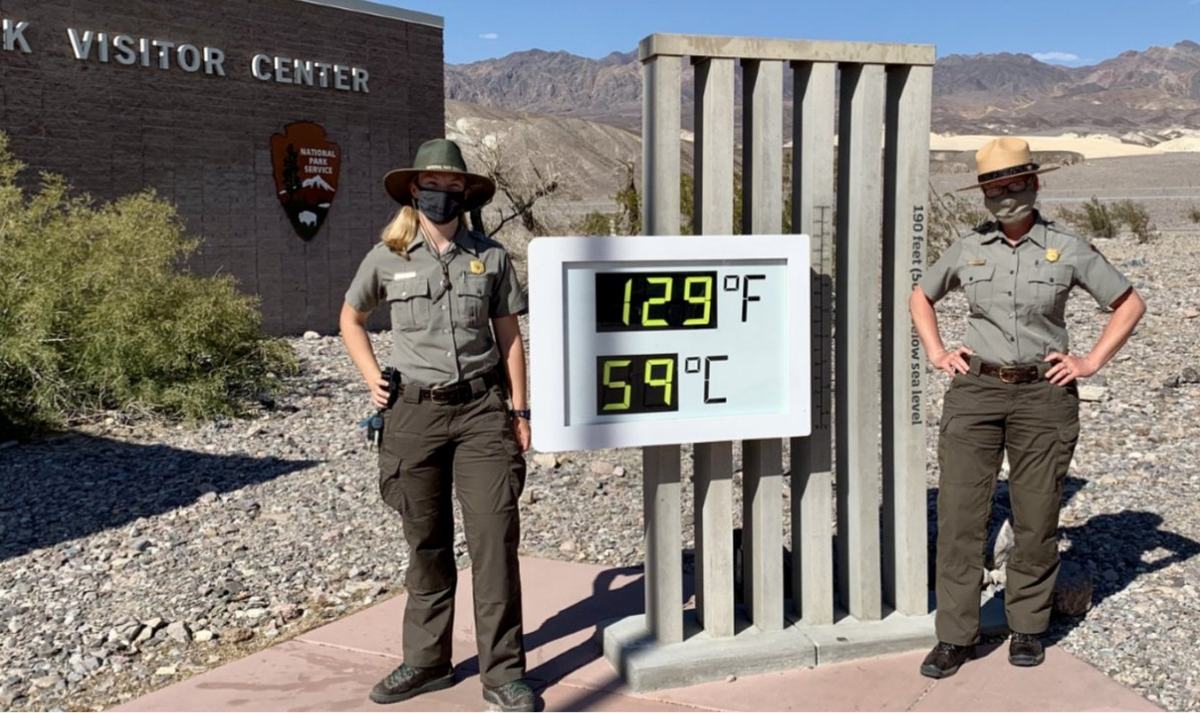
Alert levels, the 10 March 2025 renaming and example thresholds per the National Weather Service, Wikipedia’s Extreme heat warning entry, WMNF and Fox Weather, 2026. Local criteria vary by NWS office — check weather.gov for your own county. General information, not a substitute for official guidance. Photo: the Furnace Creek thermometer, Death Valley, at 129°F (public domain, National Park Service).