
If you saw a Phoenix storm described as “Category 5” and assumed the term had always existed, it has not. It is new in 2026, and it does not do what most people assume.
What PHX-DUST Is
Dust storms are among the most disruptive and dangerous events of Arizona’s monsoon, and until now there was no standard way to say how bad one was. You could say “huge”, and that was it.
The Phoenix Dust Storm Scale fixes that with a 1-to-5 rating, deliberately modelled on the Saffir-Simpson hurricane scale.
| What it measures | Average dust concentration over a one-hour period |
| Category 1 | Lowest dust concentrations |
| Category 5 | Extreme — 5,000 µg/m³ and beyond |
| Also weighed | Geographic extent, duration, wind gust speed |
The Detail Everyone Gets Wrong
A hurricane category is a forecast — you are told a Category 4 is coming and you act. PHX-DUST is not that.
Your warning still comes from the National Weather Service in the usual way. The category arrives afterwards, in the write-up.
The Letters After the Number
A full rating can look like “Category 5 WLH”. The letters are sub-modifiers:
| Code | Meaning |
|---|---|
| W | Widespread — over 50% of monitoring stations exceed 500 µg/m³ |
| I | Isolated — below 50% of stations |
| L | Long-duration — 3+ hours with at least one station above 500 µg/m³ |
| S | Short-duration — under 3 hours |
| H | High wind gust — measured gusts above 25 mph |
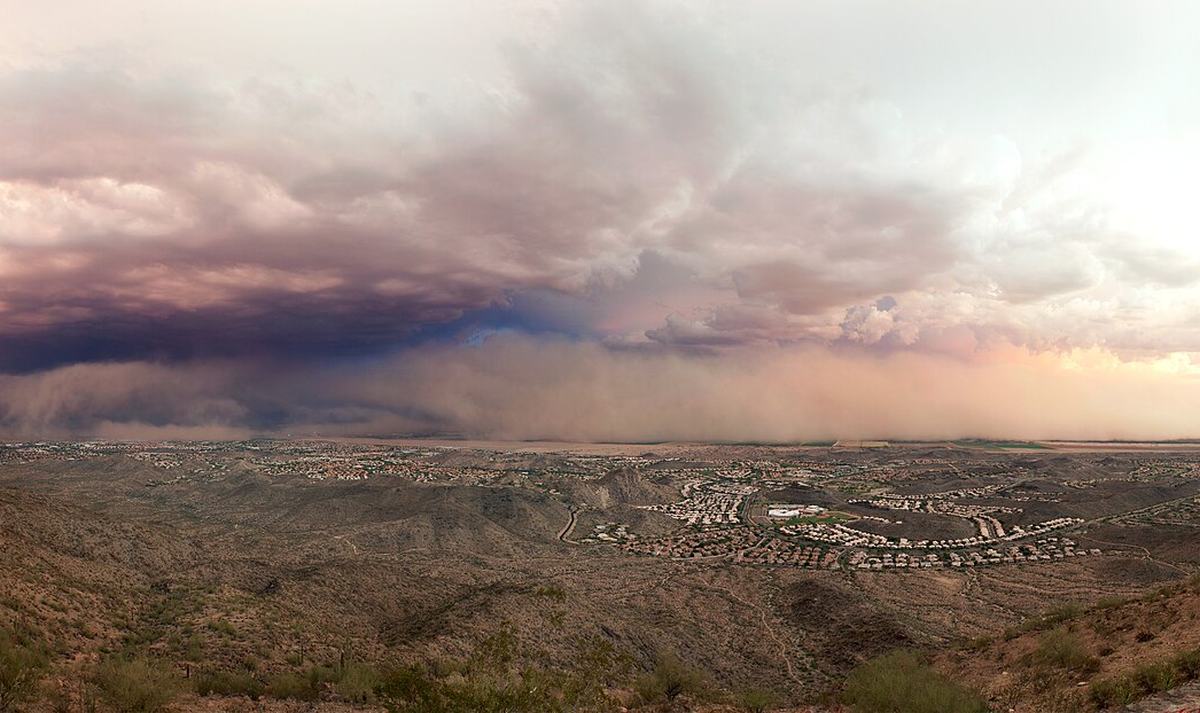
The infamous 5 July 2011 Phoenix dust storm — the one in every photograph of a dust wall swallowing the valley — would be a Category 5 WLH: widespread, long, and with high gusts.
Haboob and Dust Storm Are Not the Same Word
A haboob is a specific kind of dust storm: one driven by the downdraft or outflow winds of a collapsing thunderstorm. That is why haboobs arrive as a moving wall.
So: all haboobs are dust storms, but not all dust storms are haboobs. A dust storm can also be raised by ordinary strong winds with no thunderstorm involved.
Who Built It
The scale came from a collaboration of 22 researchers, meteorologists, public agencies and community partners, led by Arizona State University, with input from broadcast meteorologists. The work was published in the Bulletin of the American Meteorological Society.
That co-operative design is the point: a scale is only useful if the weather service, the health agencies, the researchers and the TV meteorologists all use the same numbers.
Frequently Asked Questions (FAQ)
What is a Category 5 dust storm?
The top of the Phoenix Dust Storm Scale — average dust concentration of 5,000 µg/m³ and above over an hour.
Is the category a warning?
No. It is assigned after the storm from recorded data. Warnings still come from the National Weather Service.
What do the letters like WLH mean?
W widespread, I isolated, L long-duration, S short, H high wind gust.
What is the difference between a haboob and a dust storm?
A haboob is a dust storm caused by thunderstorm outflow. All haboobs are dust storms; not all dust storms are haboobs.
What should I do if I am driving into one?
Pull Aside, Stay Alive — get fully off the road, park, foot off the brake, all lights off.
Scale structure, category and letter-code thresholds, and the development team per Arizona State University’s School of Geographical Sciences and Urban Planning and the Bulletin of the American Meteorological Society (Krahenbuhl et al.), with reporting from AZFamily, KTAR and Weather.com, July–August 2026. Full per-category thresholds beyond Category 5 are set out in the published paper. Driving guidance per Arizona’s Pull Aside, Stay Alive campaign. General information — follow official instructions during any storm. Photo: the 5 July 2011 Phoenix dust storm (CC BY-SA 2.0, Wikimedia Commons).