
The winter outlook is out, it is being shared everywhere, and the version most people see is three sentences long. Here is the forecast, and then the three things that get cut.
What It Actually Says
The Farmers’ Almanac describes winter 2026–27 as “a season of sharp contrasts”:
| Region | What is forecast |
| The South | An active storm track — repeated systems rather than a quiet winter |
| The North | Quick bursts of snow and bitter cold rather than one long freeze |
| The Northeast | The awkward mix: rain, sleet, ice and heavy wet snow |
| Elsewhere | Milder stretches broken by short cold snaps |
That Northeast line is the one worth noting. Heavy wet snow and ice are what bring down power lines; a forecast of “mix” is in practice worse for infrastructure than a forecast of cold and dry.
Cut Bit 1: It Is El Niño, Not La Niña
People search for “La Niña winter” out of habit, because recent seasons trained them to. This forecast is built on a predicted strong El Niño — the opposite phase.
That matters, because the two produce close to opposite patterns across the United States. If you carry over what you learned in a La Niña winter, you will have the wrong expectations for the wrong regions. We covered what a strong El Niño does, region by region, here.
Cut Bit 2: There Are Two Almanacs, and They Are Not the Same
This one causes real confusion, because the names are almost identical and both publish a winter forecast every year.
| Farmers’ Almanac | The Old Farmer’s Almanac |
| Founded 1818 | Founded 1792 |
| Formula devised by first editor David Young | Formula devised by Robert B. Thomas |
| Different companies. Different formulas. Different forecasts. | |
So when a headline says “the almanac predicts”, the useful next question is which one. They frequently do not agree, and a screenshot rarely says which is being quoted.
Cut Bit 3: How the Forecast Is Actually Made
Not with weather models. The Farmers’ Almanac uses a formula devised in 1818 by its first editor, and the inputs are astronomical rather than meteorological:
- Sunspot activity
- Tidal action of the Moon
- Position of the planets
- And, per the publication itself, other factors it does not disclose
None of that is hidden or scandalous — the almanacs say it openly. It simply means the forecast cannot be checked, replicated or argued with the way a meteorological model can.
So Is the Almanac Accurate?
Here the claim and the measurement part company.
| The publications’ own claim | at least 80%, 16–18 months ahead |
| Academic check — five years of monthly forecasts against recorded weather, by John Walsh of the Department of Atmospheric Sciences | 51.9% precipitation 50.7% temperature |
Fifty-one per cent on a two-way question is what a coin gets. That is the honest headline number, and it is the one missing from almost every share.
To be fair to the almanacs: an 80% claim is self-assessed, and a forecast of “colder than normal” over a whole month and a whole region can be scored generously or strictly depending on who is scoring. That is precisely why an outside check matters.
Where Is the Real Forecast?
The official US winter outlook comes from NOAA’s Climate Prediction Center, and it typically arrives in the autumn — it had not been released for 2026–27 when this was written.
It also looks different from what people expect. NOAA does not tell you it will snow on a particular week. It publishes probabilities — the chance that a season runs warmer, colder, wetter or drier than average across a region. Less satisfying to share, considerably more honest about what is knowable eight weeks out.
What to Actually Do With This
- Do not plan around it. No long-range winter forecast, from anybody, is precise enough to schedule around.
- Do use it as a nudge. If you live in the Northeast, an ice-and-wet-snow winter is a reason to check the generator and the roof before October, whoever forecast it.
- Wait for NOAA for the seasonal probabilities, and use the ordinary 7-day forecast for anything you are actually deciding.
Frequently Asked Questions (FAQ)
What is the winter forecast for 2026–27?
The Farmers’ Almanac predicts “a season of sharp contrasts” — an active southern storm track, quick bursts of snow and bitter cold in the North, and rain, sleet, ice and heavy wet snow in the Northeast.
Is the Farmers’ Almanac accurate?
It claims 80%+. An academic comparison of five years of monthly forecasts against recorded weather found 51.9% for precipitation and 50.7% for temperature — close to chance.
How does the Farmers’ Almanac make its forecast?
With a secret formula from 1818 using sunspots, lunar tides and planetary positions. Only one person is said to know it, under the pseudonym “Caleb Weatherbee”.
Will winter 2026–27 be a La Niña winter?
No — the forecast is built on a predicted strong El Niño, which produces close to the opposite pattern.
When does NOAA release its winter outlook?
NOAA’s Climate Prediction Center issues the official seasonal outlook in the autumn. It had not been published for 2026–27 at the time of writing.
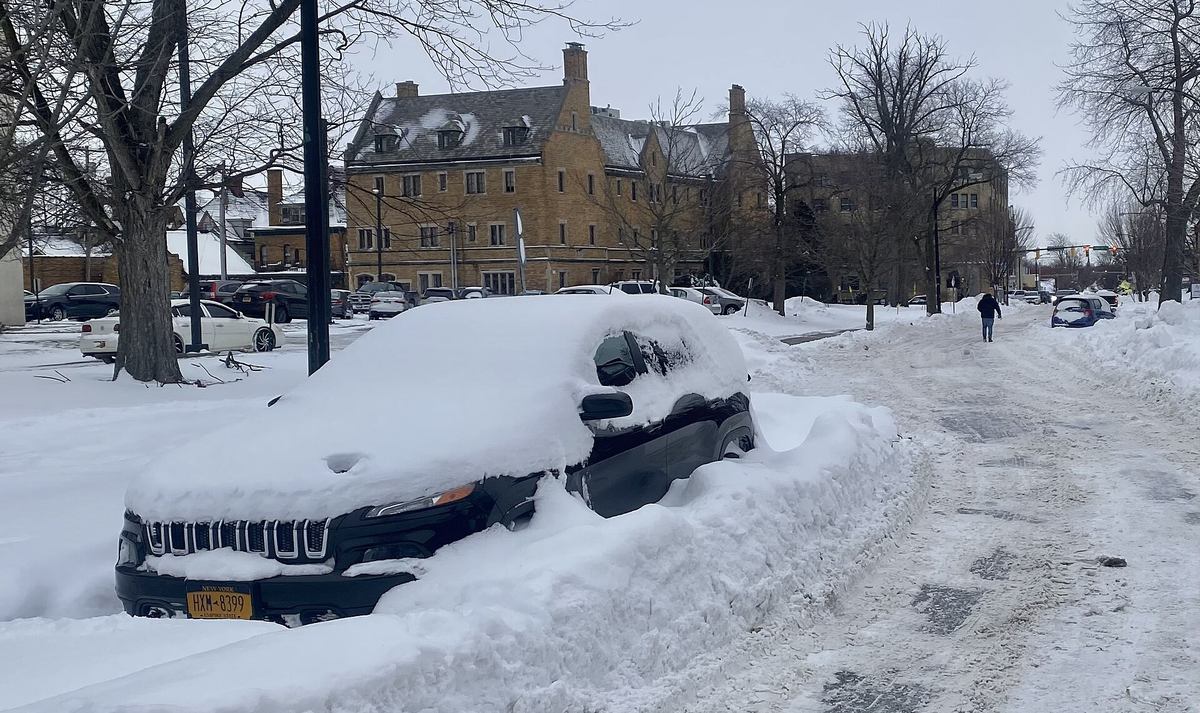
Winter 2026–27 forecast wording and the El Niño basis per the Farmers’ Almanac and coverage of its release, August 2026. Formula inputs, the 1818 origin, the “Caleb Weatherbee” pseudonym, the 1792 founding of the separate Old Farmer’s Almanac and the publications’ own accuracy claims per the almanacs and reporting on them. Independent accuracy figures from a five-year study by John Walsh, Department of Atmospheric Sciences, as reported. Long-range seasonal forecasts are not a substitute for the National Weather Service short-range forecast. Photo: a car buried on West Utica Street, Buffalo, New York after the December 2022 blizzard, by Andre Carrotflower, CC BY-SA 4.0 via Wikimedia Commons, cropped — an illustration of a past storm, not a prediction for this winter.