
The Perseids come every August. 2026 is different for one reason, and it is worth understanding before you plan a night around it.
The Moon Is Gone
The single thing that ruins a meteor shower is moonlight. A bright moon floods the sky and only the very brightest meteors survive it.
This year the moon is new on 12 August and 0% illuminated on peak night. There is effectively no natural light pollution at all — which is as good as the conditions get.
The Time Trap
Every guide quotes the peak as 14:53 UTC on 13 August. That figure is correct and, for an American reader, almost useless — because it lands around the middle of the day across the United States.
Meteor showers do not switch off either side of the maximum. The practical answer:
| When | What to expect |
|---|---|
| After midnight → dawn, 12 & 13 Aug | The best window. Highest rates, darkest sky |
| Late evening, 12 Aug | Fewer, but bright ones — and you can do it from a garden chair |
| Nights either side | Still well worth going out; the shower does not have a hard edge |
Why After Midnight Is Always Better
This is the bit that makes people trust the advice instead of just following it.
Before midnight you are on the trailing side of the Earth as it moves through the debris stream — meteors have to catch up with you. After midnight your side of the planet has rotated to face forward into the stream, so you are running into the debris head-on.
Same shower, same night, far more meteors — purely because of which way you are facing.
The Other Thing Happening on 12 August: a Total Solar Eclipse
The Perseids are not the only reason 12 August is on astronomers’ calendars this year. A total solar eclipse falls on the same date.
The path of totality is narrow and mostly remote: a stretch of Siberian Russia, eastern Greenland, the west coast of Iceland including Reykjavík, then northern Spain and a small corner of north-eastern Portugal.
| Where | What you get |
| Iceland | The longest totality — up to 2 min 18 s at maximum. Partial from about 16:47 GMT, totality around 17:48 GMT. |
| Northern Spain | Roughly 1 min 42–45 s in Burgos, León, Valladolid and Soria — and low in the sky, close to sunset. |
| United States | Partial only. Totality does not reach the US at all. |
At that level the sky does not darken, and there is no moment where it is safe to look without protection. A partial eclipse requires eye protection for its entire duration — the brief unaided viewing window that exists during totality does not exist here, because totality never happens over the US.
The good news for meteor watchers: the eclipse is a daytime event and the Perseids are a predawn one, so the two do not compete. If you are in the north-east you can catch a partial eclipse in the afternoon and then go out again after midnight for the shower.
You Do Not Need Equipment
- No telescope, no binoculars. Both narrow your field of view, and meteors can appear anywhere. Naked eye wins.
- Give your eyes 20–30 minutes to adapt to the dark — and then do not look at your phone, which resets it instantly.
- Get away from streetlights. This matters far more than any gear.
- Lie back and take in as much sky as possible. Do not stare at one spot.
Which Direction Do You Look?
The meteors appear to radiate from the constellation Perseus — that is where the name comes from — but you should not stare at it.
Meteors near the radiant appear short because they are coming almost straight at you. The long, dramatic streaks appear away from it. Face a generally dark part of the sky and let your peripheral vision do the work.
Frequently Asked Questions (FAQ)
When is the Perseid meteor shower in 2026?
It peaks late on 12 August into the predawn of 13 August, with the maximum predicted for 14:53 UTC on 13 August.
What is the best time to watch?
After midnight until dawn on 12 and 13 August. The quoted UTC peak is daytime in the US.
Will the moon interfere this year?
No. The moon is new on 12 August and 0% illuminated on peak night.
How many meteors per hour?
Under a dark sky, observers frequently report 90 an hour or more.
Do you need a telescope?
No. A telescope narrows your view. Use your eyes and take in as much sky as you can.
Is there a solar eclipse on 12 August 2026?
Yes — a total solar eclipse crossing Siberia, eastern Greenland, western Iceland, northern Spain and a sliver of Portugal. Maximum totality is 2 min 18 s.
Can you see the August 2026 eclipse from the US?
Partial only — totality does not reach the US. Maine, New Hampshire and Vermont lead the lower 48 at about 15–28%. Eye protection is needed throughout.
Will the eclipse spoil Perseid viewing?
No. The eclipse is in daylight; the Perseids are best after midnight. They do not compete.
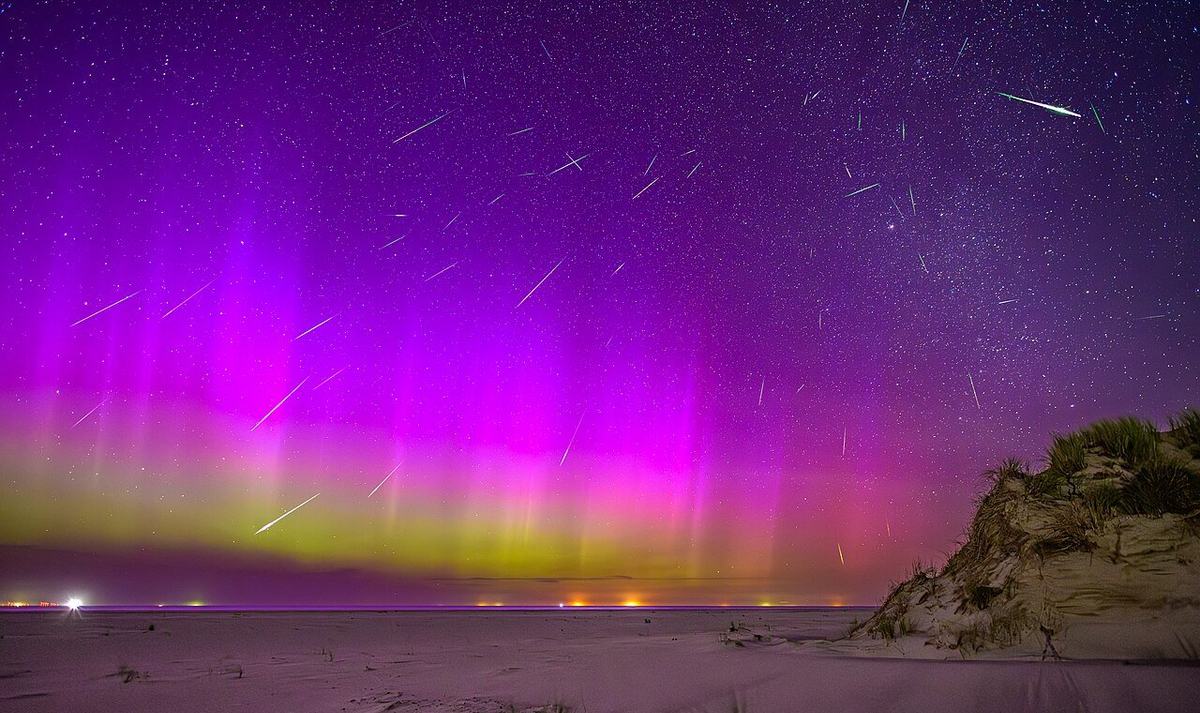
Peak timing, the 14:53 UTC maximum, moon phase and observed hourly rates per EarthSky, Space.com, the Old Farmer’s Almanac, the American Meteor Society and In-The-Sky.org, August 2026. Rates depend heavily on sky darkness and local conditions. Photo: a composite night-sky image showing multiple Perseid meteors with an aurora (CC BY 4.0, Wikimedia Commons) — a single exposure never captures this many.