
Two true sentences that sound contradictory: this is a total solar eclipse, and nobody in the United States will see a total solar eclipse. Both are correct, and the gap between them is why so many people are about to be disappointed — or hurt.
Where Totality Actually Goes
The path of totality is narrow and mostly runs over water and remote land:
| Where | What you get |
| Siberian Russia | Totality around the middle of the day |
| Eastern Greenland | Late afternoon |
| Western Iceland, incl. Reykjavík | The longest totality — up to 2 min 18 s. Partial from about 16:47 GMT, totality about 17:48 GMT. |
| Northern Spain | About 1 min 42–45 s in Burgos, León, Valladolid and Soria — very low in the sky, close to sunset |
| North-east Portugal | A small corner, also near sunset |
| United States | Partial only. No totality anywhere. |
What Time, If You Are in the US
The partial eclipse is visible in a broad band from Alaska to North Carolina. Roughly:
- Alaska — morning.
- Northern contiguous states — begins around midday.
- Further east — runs into the middle of the afternoon.
The best-placed state in the lower 48 is Maine, and its timings are the useful anchor:
| Maine (EDT) | |
| Eclipse begins | about 12:43–12:56pm |
| Maximum | about 1:52pm |
| Eclipse ends | about 2:46–2:52pm |
Times shift by a few minutes across a state and by more across the country, so check a local time for your own town before setting an alarm.
“Magnitude 0.313” Does Not Mean 31% of the Sun
You will see two different-looking numbers quoted for the same place, and this is why.
Practically: expect a Sun with a noticeable bite out of it. Not darkness, not stars, not a visible corona.
Do You Need Glasses for a Partial Eclipse?
Yes — for all of it, without exception.
This is where people carry over the wrong lesson from 2024. During a total eclipse there is a brief interval, only while the Sun is completely covered, when it is safe to look unaided. That interval exists only inside the path of totality.
A partial eclipse never has it. At 28% coverage the remaining 72% of the Sun is exactly as damaging as it is on an ordinary afternoon, and the reduced glare makes it easier to stare without discomfort — which is precisely the danger.
- Use certified eclipse glasses, and check them for scratches or pinholes first.
- Sunglasses do not work. Not stacked, not polarised, not very dark ones.
- Never look through a camera, phone, telescope or binoculars while wearing eclipse glasses — the optics concentrate the light and can burn straight through the filter.
- Free and safe: a pinhole projector. Punch a hole in card and let the Sun project onto the ground. A colander or a straw hat does the same thing, dozens of times over.
When Is the Next One Over America?
Not soon — and this is the question that follows every eclipse.
| Date | Where |
| 23 August 2044 | Begins in Greenland, mostly Canada — only three US states: Montana, North Dakota, South Dakota |
| 12 August 2045 | Coast to coast — California to Florida |
Look at that second date again. The next coast-to-coast American total eclipse falls on 12 August 2045 — the same calendar day as this one, exactly nineteen years later.
And the Perseids Are the Same Night
Conveniently, they do not compete. The eclipse is a daytime event; the Perseid meteor shower peaks late on 12 August into the predawn of the 13th, with no moonlight this year. Partial eclipse in the afternoon, meteors after midnight. We covered the shower separately here.
Frequently Asked Questions (FAQ)
What time is the solar eclipse on 12 August 2026?
In Maine it runs from about 12:43pm to 2:52pm EDT, peaking near 1:52pm. Alaska sees it in the morning; the northern contiguous states from around midday.
Where can you see the total eclipse?
Siberia, eastern Greenland, western Iceland including Reykjavík, northern Spain and a corner of Portugal. Not the United States.
Do I need glasses for a partial solar eclipse?
Yes, for the entire duration. The safe naked-eye moment exists only during totality, and totality does not reach the US.
How much will be covered in the US?
Roughly 15–28% in the best-placed contiguous states — Maine, New Hampshire and Vermont. It will not get dark.
When is the next total solar eclipse in the US?
23 August 2044, clipping only Montana, North Dakota and South Dakota — then a coast-to-coast one on 12 August 2045.
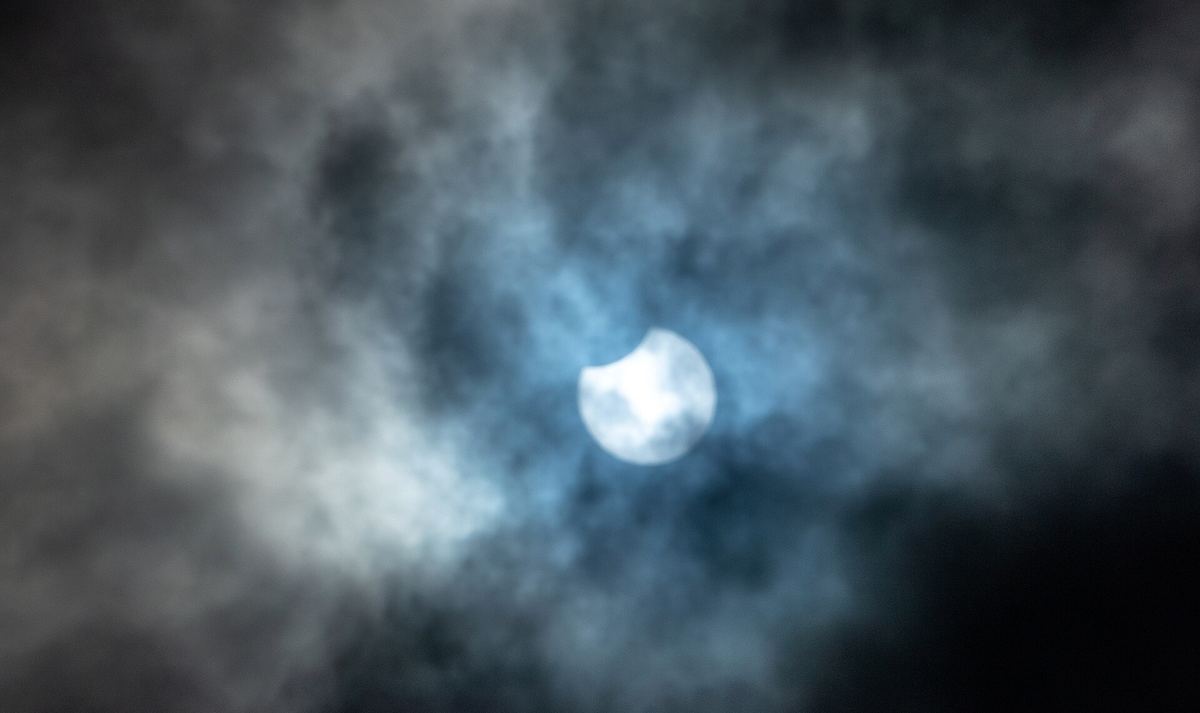
Path of totality, duration figures, Iceland and Spain timings, and US visibility per NASA and published eclipse data for 12 August 2026. Maine start, maximum and end times and the 0.313 magnitude figure per timeanddate.com data for Maine; times vary by town. Coverage percentages for the best-placed contiguous states per eclipse reporting. Dates and paths of the 2044 and 2045 US total eclipses per CBS News and NASA. Eye-safety guidance follows standard advice from NASA and the American Astronomical Society — only certified eclipse viewers should be used, and never in combination with a camera, telescope or binoculars. Photo: a partial solar eclipse through cloud, Tuntorp, Sweden, by W.carter, CC BY-SA 4.0 via Wikimedia Commons, cropped.